
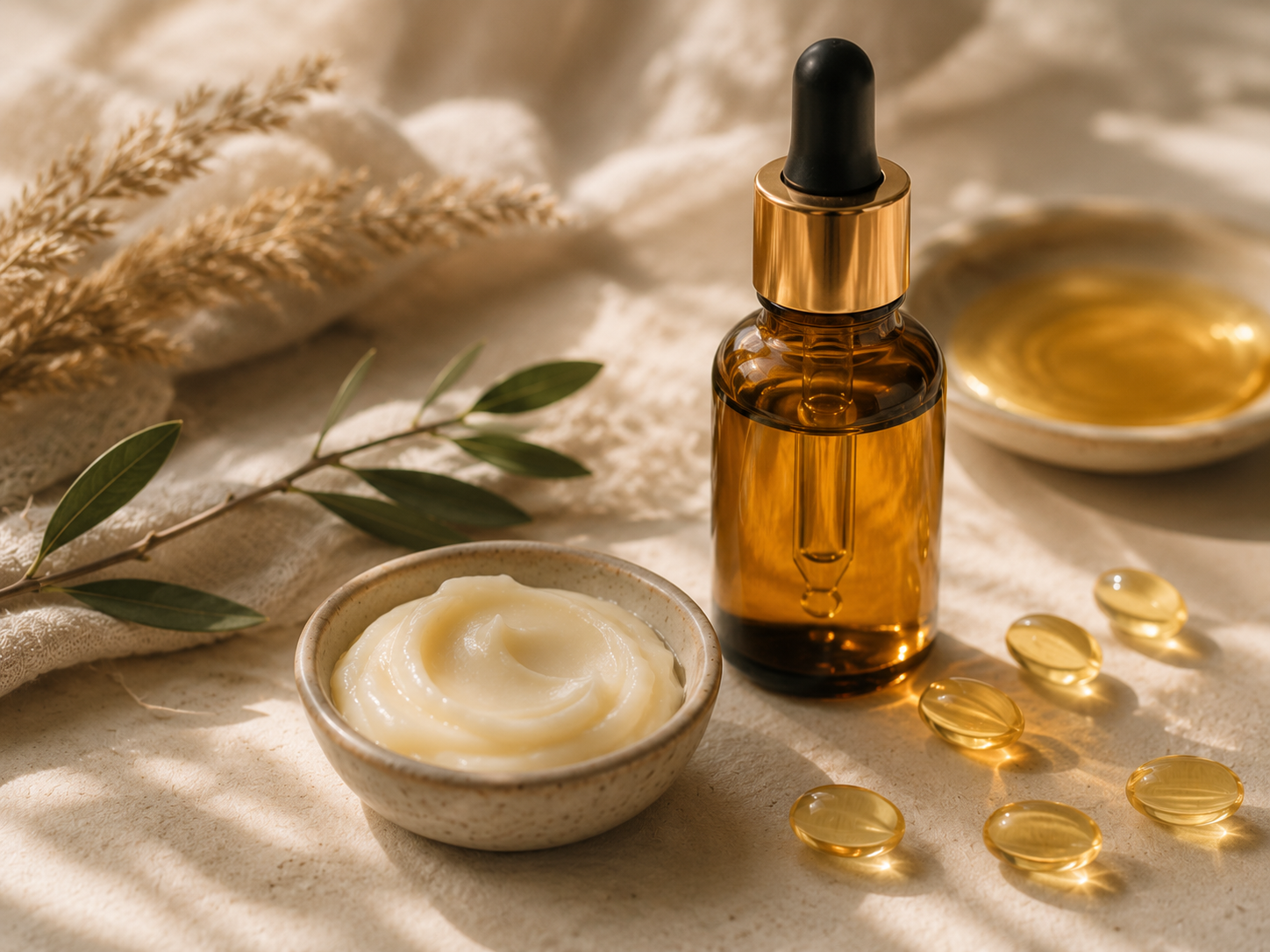
Vitamin E appears on countless skincare labels, often surrounded by claims that are much larger than the ingredient itself. Its most dependable role in an oil-based balm is straightforward: it can help support the formula by slowing oxidation of certain oils.
On an ingredient list, vitamin E may appear as tocopherol or tocopheryl acetate. These forms are related but not identical, and their behavior depends on concentration and the rest of the product.
In a balm stick, vitamin E can contribute to skin feel while also helping protect delicate oils from becoming rancid too quickly. It is not a complete preservative system, and it does not prevent microbial growth in products that contain water. In a water-free formula, clean handling and good packaging still matter.
Vitamin E is also used as a skin-conditioning ingredient. It can help the surface feel smooth and comfortable, particularly in formulas for dry areas. However, it should not be promoted as a guaranteed scar remover, wrinkle cure, or treatment for skin disease. Evidence and individual response are more complicated than those promises suggest.
Some people are sensitive to vitamin E or to other ingredients in vitamin E-containing products. Patch testing remains useful, especially if you have reactive skin.
When evaluating a formula, do not judge it by whether vitamin E appears near the top or bottom of the ingredient list. Effective use depends on formulation, not on visual prominence. A supporting ingredient can be valuable at a relatively low percentage.
Vitamin E is most interesting when we allow it to be practical. It helps a balm stay fresh, contributes to conditioning, and supports the overall formula. That is enough. Good skincare does not need every ingredient to be a hero.